


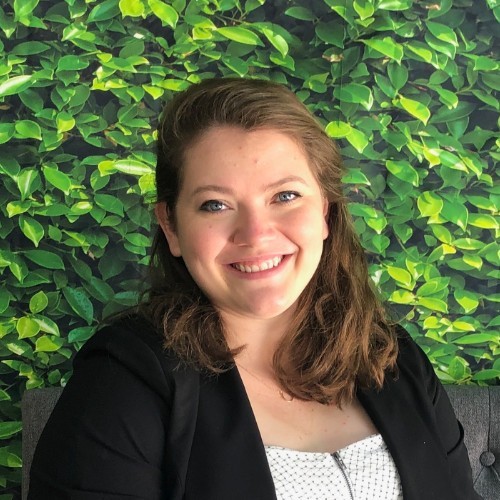
 Today we’d like to introduce you to Bonnie Berkley.
Hi Bonnie, we’re thrilled to have a chance to learn your story today. So, before we get into specifics, maybe you can briefly walk us through how you got to where you are today?
I grew up in San Antonio, Texas, and always had a love for science. I thought the human body and all the intricate systems it’s able to keep in check was fascinating, so I thought I was destined to be a doctor. As a college biology major and chemistry minor, I took as many science classes as I could (I ended up taking almost double the necessary biology credits to major… can you double major in the same subject?). I studied for the MCATs, took them, did okay, but realized my heart wasn’t really in it anymore. I did a pre-Vet internship; also, not for me. I scribed in the ER for 2 years while applying to PA schools; but, I ultimately decided that wasn’t for me either. Spending that much time in the ER made me question why so many people were there for the “wrong” reasons. Why wasn’t this “frequent flyer” getting the help they needed from their PCP? How come the person in for psych clearance comes in with the police instead of mental health professionals? And, the more I started asking these questions, the more I realized that the issues that led to these circumstances lay far beyond the hospital walls. So, I finally found my answer to what I wanted to be when I grew up: a Public Health Professional. I got my MPH and started working for the Social and Health Research Center, INC. A non-profit committed to improving the social and health wellbeing of populations at-risk, and where we expect to improve health behaviors with innovative and evidence-based health programs to control chronic diseases such as obesity, hypertension, and type 2 diabetes and to design better instruments to evaluate program effectiveness.
I’m sure you wouldn’t say it’s been obstacle free, but so far would you say the journey have been a fairly smooth road?
I always knew I wanted to be in the health care field. Just not in what capacity. That road would have seemed bumpy IF I had the mindset of needing to figure everything out right away. And, until I realized that adults don’t have everything figured out and that they don’t have to have everything figured out, I was really stressed about what my future was going to hold. I thought when I graduated high school, I needed to have the rest of my life mapped out and that any deviation from that plan would wreck my future. And that couldn’t be farther from the truth. The path of self-discovery I allowed myself to explore lead me to where I am today and where I need to be. If I hadn’t allowed myself to be open to the world of possibilities that being in the health care field can mean, I would never have ended up where I am today. And, I probably wouldn’t have been as happy.
As you know, we’re big fans of you and your work. For our readers who might not be as familiar what can you tell them about what you do?
I am the Deputy Director of a non-profit that aims to implement health programming to control chronic diseases such as obesity, hypertension, and type 2 diabetes. I head and work with a team of 5 highly skilled and diverse educators to design, implement, and evaluate health programming. I also work with local and national grantmakers to promote our work and get our services out to high-risk and low-income individuals at low to no cost. Every day, I try and think of barriers and how we can break down those barriers to increase access to health education and better the health of children and families.
Part of being a Public Health Professional is learning to wear many hats. I write grants, create and manage every aspect of projects from the budget to implementation, best practices, conduct performance reviews, evaluate our marketing strategy, and the list goes on and on.
What are you most proud of brand-wise? I am proud that we are able to make positive changes in a very difficult field. Not only are we tackling some of the biggest health crises in the country, but we are taking a preventative approach. We have programming for preschoolers teaching them about what type 2 diabetes is. When I was three years old, there was no way I knew why fiber was important and why I should be exercising 60 minutes a day. But kids in our program do. And, they tell their parents and affect change in their families health behaviors.
What do I want readers to know: Pretty much everyone is at risk for hypertension and type 2 diabetes. Just because your parents didn’t have it or you think you eat healthily, doesn’t mean you won’t have to deal with these life-altering diseases one day. Our culture has normalized having these diseases and the unhealthy behaviors that lead to developing these diseases. And, we see enormous health disparities within these diseases, meaning that low-income POC are much more likely to 1) develop these diseases and 2) suffer worse outcomes.
We love surprises, fun facts and unexpected stories. Is there something you can share that might surprise us?
We keep a Kosher household. My SO is Jewish so we don’t mix meat and dairy or bring pork or shellfish into the house. This has DRASTICALLY changed the way that I cook, and in my opinion, for the better.
Contact Info:
- Email: bberkley@sahrc.org
- Website: https://www.sahrc.org/
- Facebook: https://www.facebook.com/bienestar210sahrc